


Pardon Our French

Emmanuel Macron stood at L'Ile Longue submarine base on March 2nd and said something European leaders have been dancing around for years. "To be free, one needs to be feared." Then he announced France would increase its nuclear warhead count for the first time since at least 1992, that French nuclear-armed aircraft would be temporarily deployed to allied countries, including Germany, Poland, the Netherlands, Belgium, Greece, Sweden, and Denmark, and that European partners would be invited to participate in French nuclear exercises. The architecture of a European nuclear deterrent is now under construction.
The United States has spent the better part of two years signaling to Europe that the American security guarantee is conditional at best and negotiable at worst. Trump questioned NATO's Article V obligations as far back as 2018, publicly questioning why American troops should defend Montenegro, then the most recent NATO member, and as recently as June 2025, told reporters that his commitment to the mutual defense guarantee "depends on your definition." His Vice President, in a leaked Signal message, expressed that he "hated bailing Europe out again," while Defense Secretary Pete Hegseth replied that he fully shared the "loathing of European freeloading." His administration has oscillated between threatening to abandon NATO entirely and demanding financial concessions in exchange for continued participation, like a mob-like shakedown. European defense ministers quickly concluded that the US cannot be relied on. Macron's speech at L'Ile Longue is the formal, strategic response to that conclusion.
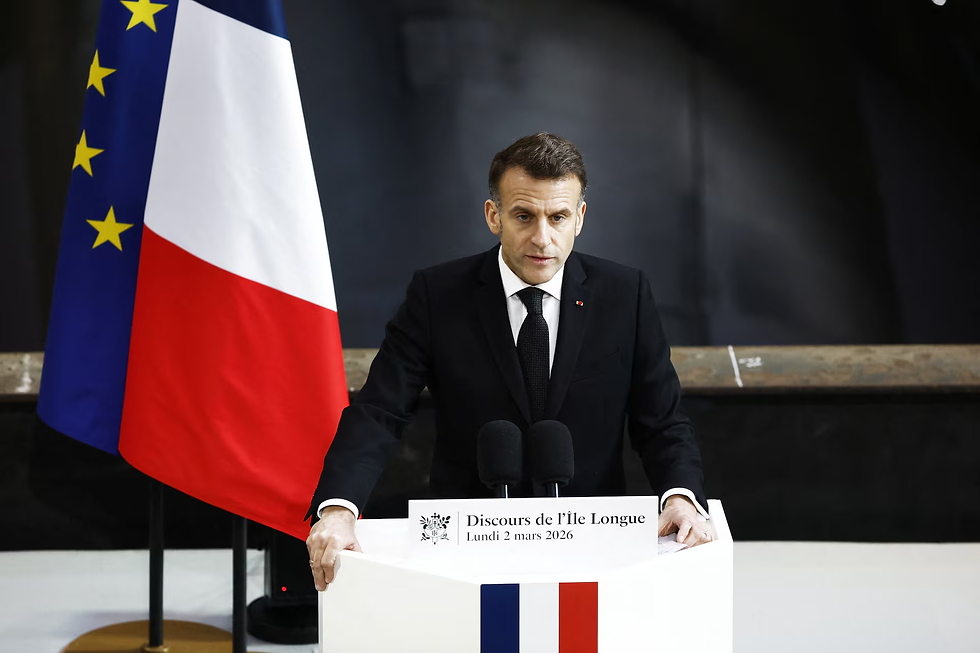
A deterrent functions only when an adversary believes it will be used. The credibility of that threat depends entirely on the political will of the president holding the launch codes. When that president publicly questions whether his country's allies are worth defending, the deterrent degrades. It might not be a giant signal that Europe is open for Russia to march through, but it could be enough to shift Putin's calculation. Macron explicitly said that recent changes in US defense strategy have demonstrated a refocusing of American priorities and encouraged Europe to take greater responsibility for its own security.
The joint declaration Macron and German Chancellor Friedrich Merz issued makes this ambition clear. The two countries committed to deepening deterrence integration, including German conventional participation in French nuclear exercises and joint visits to strategic sites. Paris and Berlin also announced a "high-ranking nuclear steering group" between the two countries to formalize the relationship. Germany, the country whose post-war constitutional order was built on an explicit cultural rejection of militarization, is now considering direct involvement in nuclear deterrence planning. The speed of this shift, in only a few years, tells you everything about how seriously European leaders are assessing the reliability gap left by Washington.
Decision-making authority over French nuclear weapons remains exclusively with the French president. Macron was explicit that France will not share "the ultimate decision" to use nuclear weapons, which under the French constitution remains solely with the president. What allies get is the presence of French nuclear-capable aircraft on their territory, participation in deterrence exercises, and the signal that France's deterrent extends beyond French borders. French strategic air forces will be able to "spread out across the European continent" to "complicate the calculations of our adversaries," Macron said. NATO's deterrent worked for 75 years because the alliance created a shared security architecture that made attacking one member an attack on all. Macron is constructing a European version of that architecture, with France at its center.
The critics will argue that expanding the French deterrent risks provoking Russia and undermines the Nuclear Non-Proliferation Treaty. These concerns deserve a serious hearing. Jean-Marie Collin of the International Campaign to Abolish Nuclear Weapons argued the expansion "reflects a dynamic of participation in an arms race" and that Russia would likely interpret it as a major provocation (but, to be fair, Russia considers any pushback a major provocation). They also need to be weighed against what Europe has increasingly tolerated for the better part of a decade: a NATO structure whose largest member has treated collective defense transactionally by attaching conditions and timelines to commitments that were supposed to be unconditional. Businesses require stability, as any observer of the post-tariff market chaos can confirm. Military alliances require it even more. A deterrent that applies or does not depending on who won the last American election is a strategic liability, and Europe waking up to the fact that it has carried that liability long enough.
This brings us to the question Macron has been pushing since at least his 2017 Sorbonne speech on European sovereignty: does this mark the beginning of a genuinely autonomous European defense capability? Defense and security expert Alain Bauer put it plainly to NPR: France is "the only free and independent nuclear power in Europe," noting that even the British deterrent operates under heavy American influence. Macron also announced that Paris, London, and Berlin would "work together on very long-range missile projects," presenting it as part of a broader European conventional and nuclear deterrence effort.
There are significant structural issues. The UK sits outside the EU entirely, though the July 2024 Franco-British declaration coordinating their independent nuclear forces suggests that the Labour government is committed to a closer alignment. Defense procurement across European member states remains fragmented along national lines, with divergent contracts, doctrines, and political constraints complicating any move toward unified command. The strategic priorities of Poland, which Prime Minister Donald Tusk welcomed as collective armament so that "our enemies will never dare to attack us," differ materially from those of neutral states, like Austria, Malta, or, to an extent, Ireland, whose constitutional commitments preclude full participation. Macron has always acknowledged these barriers. His argument has been that they are surmountable given sufficient political will, and that sufficient political will requires sufficient external pressure.
All of this is set against the backdrop of Russia threatening EU and NATO members and Europe no longer having faith in the institutions that have defended it since World War II. Europe has moved from seeking American reassurances about NATO's durability to constructing the foundational elements of an alternative security architecture. Germany has suspended its post-war constraints on defense spending. France is expanding its nuclear posture for the first time in a generation. Eight countries are in formal deterrence talks with Paris. Each development individually represents an incremental adjustment. Collectively, they describe a continent in the early institutional stages of a defense structure that operates on European command and European doctrine. To say nothing that re-arming Europe will be incredibly expensive and difficult political decisions will have to be made in weighing the needs of a robust independent defense structure against the needs of robust welfare states.
Macron said at L'Ile Longue that Europeans must take their destiny more firmly into their own hands. The announcement was a shot across the bow to not only Moscow, but also to Washington. European leaders are no longer willing to be dragged around by American foreign policy - as European refusal to participate in Iran suggests. Whether Europe can consolidate these early institutional moves into a coherent, autonomous defense capability remains an open question, contingent on political alignment across member states that has historically proven difficult to sustain. What is no longer an open question is whether Europe has the incentive to try. American foreign policy has settled that for them.


Comments