


How Gerrymandering Works, and How It Can Backfire
In 1812, Massachusetts Governor Elbridge Gerry approved a state senate district so deliberately contorted that a newspaper drew a salamander over it and named it after him. The district's outline resembled the creature. Someone combined Gerry's name with salamander, softened the G to a "ja", and the word gerrymander has been in the language ever since. Gerry went on to become Vice President of the United States, because American politics has always had a high tolerance for this kind of thing.
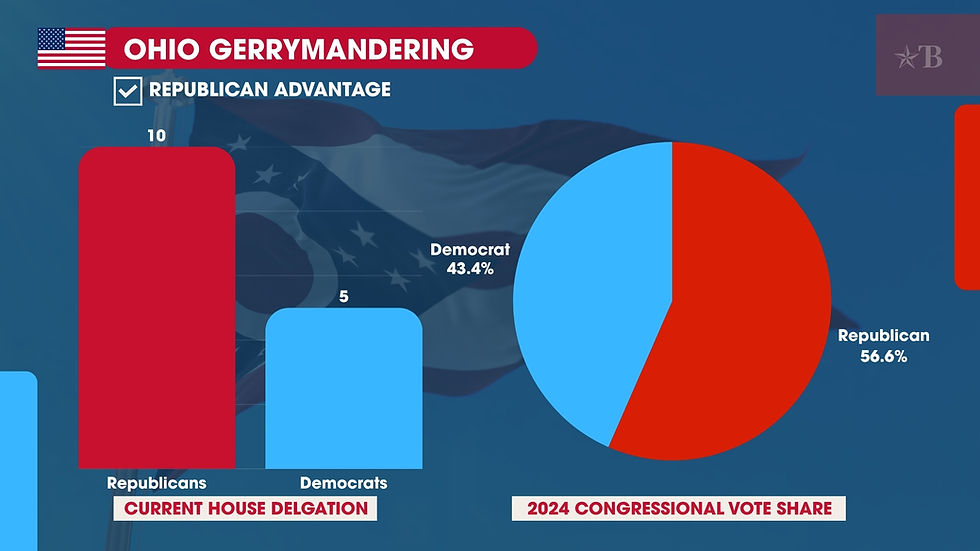
Over the past year, both major American political parties have been engaged in a redistricting arms race ahead of the upcoming midterms. By most projections, it will produce almost no net partisan gain for either side. That outcome is not a coincidence. It is the predictable result of how gerrymandering actually works when both sides do it simultaneously.
How Districts Get Redrawn
Every ten years, almost always following the census, states redraw their congressional and state legislative districts to reflect population changes. It is also when the country reallocates House seats. Federal law locks the House at 435 members, so when the South and Sun Belt grow faster than the Midwest and Northeast, as they have been for decades, states like Texas and Florida gain seats while states like Ohio and New York lose them.
In most states, whichever party controls the state legislature draws the new maps. Both parties have done this aggressively whenever they had the chance.
The Legal Landscape
The law around redistricting evolved significantly during the past century. The Supreme Court, in a series of decisions starting with Baker v. Carr in 1962, established that districts must be roughly equal in population. Before those rulings, some state districts were so lopsided that a rural county with a few thousand people had the same representation as a city with hundreds of thousands.
Later decisions addressed racial gerrymandering, drawing district lines specifically to dilute the voting power of minority groups. The Voting Rights Act of 1965, and a body of court decisions built on top of it, established that states with a history of discrimination had to ensure minority voters had a fair shot at electing representatives of their choice. For decades, federal courts could strike down maps that packed or cracked minority communities to minimize their electoral influence.
That legal backstop is now effectively gone. The Supreme Court recently issued a six-to-three ruling in Louisiana v. Callais that struck down Louisiana's second majority-Black congressional district as an unconstitutional racial gerrymander, and in doing so, it essentially gutted Section Two of the Voting Rights Act, the primary legal tool for challenging race-based voter dilution. The majority opinion, written by Justice Samuel Alito, held that Louisiana's map used race too prominently in drawing the district and that the Voting Rights Act did not require the state to create it. Justice Elena Kagan wrote in dissent that the decision renders Section Two all but a dead letter.
Red states have not wasted any time. Alabama, Tennessee, and Mississippi have already moved to redraw their maps and eliminate existing majority-minority districts. Analysts identified twelve districts across eight southern states where Republicans can now pursue redistricting under the cover the ruling provides.
Purely partisan gerrymandering proved harder to regulate at the federal level even before Callais. In 2019, in Rucho v. Common Cause, the Supreme Court ruled that federal courts cannot review partisan gerrymandering claims at all. That is a political question, the majority said. Let the states handle it.

Packing and Cracking in Gerrymandering
When you gerrymander, you have two main tools.
Packing means cramming as many of the other party's voters as possible into a single district, letting them win that one by enormous margins while their voters are politically useless everywhere else. Cracking means taking a concentration of opposition voters, splitting them up across multiple districts, and diluting them enough that they cannot win any of them.
Both tools serve the same goal: maximizing the number of seats your party wins relative to the total votes it receives.
The Arms Race
This current round of redistricting started when President Trump pressured Texas to redraw its congressional maps in the middle of the decade, before the next census. Redrawing maps between census years, what is called mid-decade redistricting, was extremely rare before recently. Only two states had voluntarily done it since 1970. It is technically legal, depending on state law, but a strong norm existed against it, because everyone understood that one side doing it would force the other side to retaliate.
Texas passed new maps designed to flip five congressional seats currently held by Democrats. Samuel Wang at Princeton's Gerrymandering Project, which uses mathematical modeling to measure partisan bias in maps, called the Texas maps the worst partisan gerrymander of the last fifty years.
California's Democratic governor Gavin Newsom responded immediately. He put a proposition on the ballot letting the legislature bypass the independent redistricting commission California had spent fifteen years building. The measure passed with 64 percent of the vote. California voluntarily dismantled its own reform infrastructure, with Newsom framing it as a response to Texas.
Florida and Tennessee have since passed new maps netting an additional five seats for Republicans. Virginia Democrats attempted new maps creating as many as four additional Democratic-leaning districts, but Virginia's Supreme Court struck them down. Democrats are still likely to pick up two seats there based on current polling.
As of now, eight states have enacted new congressional maps, with at least one more expected following Callais. Legal challenges are active in several. When you combine redistricting in the Republicans' favor, nineteen to six at the moment, with polling that still shows a Democratic wave in November, it essentially cancels everything out.

How It Backfires
The part that does not get discussed enough is what happens when gerrymandering goes wrong.
When you crack a blue city across three or four surrounding red suburban or rural districts, you are deliberately adding opposition voters to districts you would otherwise win comfortably. Under normal conditions, your party still wins. The problem is what happens when the political environment shifts.
If there is a wave, a national environment that is particularly bad for your party, those cracked districts suddenly become competitive. You are defending them with a thinner margin than you would have had if you had left the map alone. Maps drawn to lock in a big majority tend to collapse when public opinion turns. You spread your opponents too thin across too many districts, and when the mood turns against you, you lose all of them at once.
Tennessee's Seventh Congressional District is the clearest recent example. Tennessee Republicans drew Nashville into three separate pieces and distributed each piece across otherwise safely Republican suburban and rural districts. The idea was to neutralize one of the most Democratic cities in the South.
Mark Green, the Republican incumbent, resigned from the Seventh District recently, triggering a special election. The district had gone for Trump by 22 points the previous year. Republicans had held the seat since 1983. Republican Matt Van Epps had a Trump endorsement and a strong veteran background. Democrat Aftyn Behn ran on affordability and economic pressure, a notably left-wing campaign for what is mostly a rural, very red district.
Van Epps won, but by only 8.6 percentage points. A twelve-plus point swing toward Democrats compared to 2024. Behn won the Nashville portion of the district 78 to 22. She lost the surrounding counties. The gerrymander held, but barely, in a low-turnout special election, before gas prices and other issues have added more headwind for Republicans.
If those margins hold in a genuine wave election this fall, several of the newly drawn Republican districts in Tennessee and elsewhere become competitive in ways their architects never intended.
Reform and Its Limits
The independent redistricting commission model was the most promising reform of the past two decades. California created one in 2010, removing mapmaking from the legislature and handing it to a fourteen-member citizen body specifically screened to exclude people with significant partisan ties. Michigan, Colorado, and Arizona built similar bodies.
California's proposition shows the limit of that approach. Voters will dismantle their own reforms when it is in their political interests to do so. That is a precarious foundation for any reform movement to build on.
A durable solution, if one exists, probably requires federal legislation. Congress has the authority to set standards here. The Redistricting Reform Act is the current option on the table, but this Congress, and the sitting President who accelerated this cycle, makes that outcome unlikely in the near term.
Where Things Stand
The history of American redistricting is a history of both parties using every available tool to entrench their advantages whenever they hold the power to do so, interrupted by periodic reform movements that achieve partial success before the next cycle undoes them.
The current arms race, where a red state responds to a blue state responding to a red state, is the latest iteration of that pattern. Maps drawn for maximum partisan efficiency are efficient in favorable environments and fragile in hostile ones. Tennessee's Seventh District is a preview of what that fragility looks like in practice.
Both parties are now carrying that structural risk into the midterms. Whether the maps hold depends entirely on how bad the political environment gets for Republicans between now and November.


Comments