


Can Trump Cancel the Midterms?

Something rather insane has been circulating on social media lately, passed around as settled fact the way social media does with things that aren't.
The question: can Trump cancel the midterms?
Given the last few years, it's not an unreasonable thing to wonder. A lot of things that seemed impossible have happened. So let's actually answer it, which requires understanding how legislative elections work, what the Constitution says, and where presidential power does and does not reach.
When Americans talk about elections, they usually mean presidential ones. The head of state gets the motorcade, the bully pulpit, most of the coverage, and the nuclear football. But the legislative elections that run alongside or between those cycles are just as fundamental to how democratic governance works.
The entire House of Representatives and one-third of the Senate are elected every two years. All 435 House seats cycle simultaneously. The Senate's 100 seats are divided into three classes, one cycling every two years, giving each senator a six-year term. In years without a presidential race, those are called midterms.
Article One, Section Four of the Constitution assigns the times, places, and manner of holding those elections to each state's legislature. Not the federal government. Not the President.
The short answer to whether any of that can be canceled is no. The longer answer is also no, but with several layers of why.

The first is decentralization. There is no single national election to cancel. There are 50 separate state-run processes, each administered under its own laws, by its own officials, certified through its own procedures. Many of those elections are administered at the county or local level, under rules set by the state. Federal involvement is minimal by design: Congress established a uniform Election Day back in 1845, and until recently, federal law mandated certain demographic considerations in drawing districts. Everything else, the ballots, the precincts, the machines, the counting, the certification, is state-controlled.
A presidential executive order cannot reach into the administrative apparatus of 50 independent state governments and shut their elections down. There is no mechanism for it and no law requiring states to comply. An executive order is, structurally, an internal directive to employees of the executive branch. It functions more or less like a memo from a boss, with no force over people outside that office. States can disregard them.
The Founders built it this way deliberately. They were worried about concentrated power, and wary of the scenario in which whoever held national office could use that office to stay there. Distributing election authority across the states was a built-in safeguard. You could get one person who thought he was a king elected, but it's considerably harder to get 50 state governments to agree to that.
The second layer arrived in 1933. The Twentieth Amendment is most commonly remembered for shortening the lame-duck session, moving the presidential inauguration from March to January after Herbert Hoover spent his final months in office doing nothing to address the Great Depression while FDR waited. But it also affected Congress in a way most people miss.
Congressional terms have fixed expiration dates. The Twentieth Amendment sets the end of each term at noon on January 3rd. That happens automatically. No law, executive order, proclamation, or edict changes the date.
If no midterm election were held, House members' terms would still expire on January 3rd, 2027. All 435 seats would go vacant simultaneously. The House of Representatives would cease to exist as a functioning body.
The remaining two-thirds of the Senate, the senators whose terms are not up this cycle, would continue to sit. Based on who is running this year, the chamber would flip to Democratic control by one vote.

The consequences compound from there. No House. A Democratic Senate, meaning no Trump appointees get confirmed. No appropriations bills, since those must originate in the House, meaning every government function dependent on congressional appropriation grinds to a halt. And Mike Johnson, whom some have floated as capable of maneuvering around these outcomes given his history, would not factor into any of it. He is not Speaker after noon on January 3rd. He is not even a House member. There are no House members. The apolitical Clerk of the House runs the opening session, calls the roll, and administers the oath to whoever the new majority elects as Speaker. It is all on C-SPAN.
Trump does exercise more executive authority than most recent presidents, and that is putting it mildly. He has already issued as many executive orders as Bush and Obama combined across their 16 years in office, with three years still remaining. Emergency declarations, executive orders, the expansion of war powers: all have been used aggressively. Republicans in Congress have largely declined to check any of it, which is a genuine structural problem for oversight.
But that expanded authority derives from power Congress handed to the executive branch over the past 50 years, through legislation like the National Emergencies Act and the broad delegation of discretionary power in appropriations law, and from a political environment in which Congress has chosen not to use the tools it still has. Recent primaries in Louisiana and Kentucky illustrated the dynamic: Republicans who go against Trump face his base, and they lose. The system is not broken. It is just not being used.
The judicial branch has not gone anywhere, and it is already on record stopping some of the administration's more aggressive moves.
In December 2025, the Supreme Court rejected the Trump administration's attempt to deploy National Guard troops in Illinois, finding that the administration had failed to identify any legal authority permitting the military to execute civilian law in that state. That is this Supreme Court, with three Trump appointees, ruling against the executive on a direct question of federal power.
Emergency powers do not override the Constitution. The Insurrection Act, which gets cited constantly in these conversations, authorizes the President to deploy federal troops in limited circumstances, including to suppress insurrections, domestic violence, or obstruction of federal law. It does not alter how elections are administered. It does not grant presidential authority over election timing, ballot certification, or vote counting.
Martial law, in every historical instance, has been geographically limited and temporary. It has never been applied nationally. It has never suspended federal elections. Congressional elections continued during the Civil War, when half the country was in an armed conflict with the other half and the losing half was literally under martial law afterward. They continued through the Great Depression and both World Wars.
To change how congressional elections work, beyond setting the date, requires a constitutional amendment, which requires ratification by 38 states. Thirty-eight states are not ratifying an amendment stripping them of authority over their own elections. As of this writing, Trump is underwater in every state except Idaho, North Dakota, Oklahoma, West Virginia, and Wyoming.
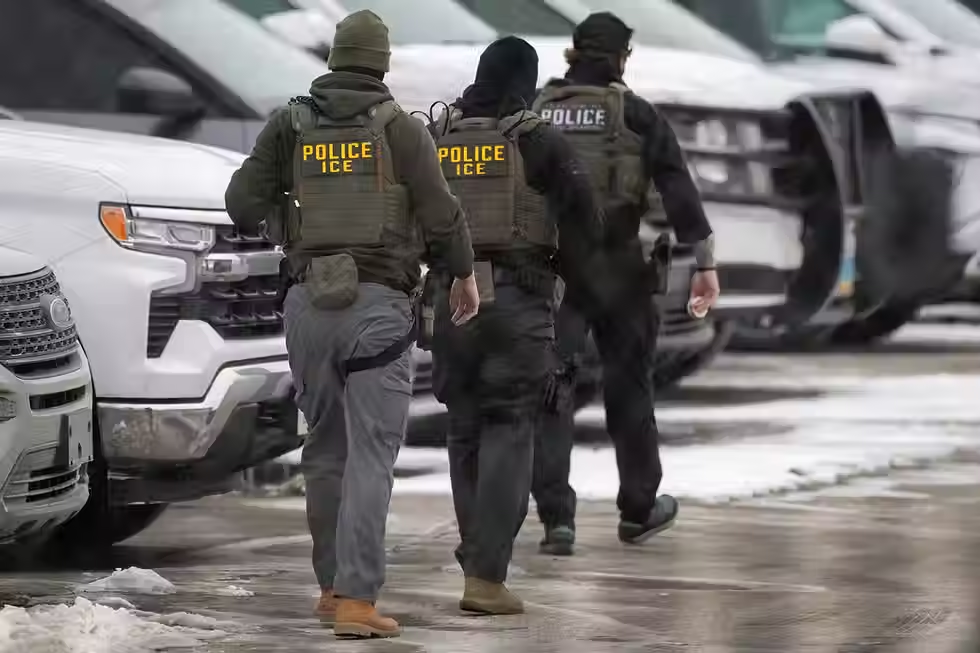
On the more theatrical possibilities: deploying ICE agents to polling sites runs into basic logistics. There are roughly 95,000 polling places in the United States. There are approximately 22,000 ICE agents. To staff those sites meaningfully, you would need nearly every federal law enforcement officer across the FBI, ATF, DEA, and a dozen other agencies. Federal law enforcement would grind to a halt. Title 18, U.S.C. § 595 prohibits using armed federal agents to intimidate voters. Most judges, regardless of bias, would issue an immediate injunction.
A final point: some on the left argue the federal government has no role in elections whatsoever, and they are not quite right. Congress has intervened before, including through the now-weakened Voting Rights Act. Article One, Section Four says Congress may at any time by law make or alter election regulations. By law. Passed by Congress, signed by the President, subject to judicial review. Not by executive order. Not by Truth Social post. Writing "hereby" or "thank you for your attention to this matter" does not make something law in a constitutional republic.
Outside of the remaining absolute monarchies, every country holds elections. Russia holds them. China holds them. North Korea holds them. They are not free, they are not competitive, and in most cases the outcome is not in doubt before voting starts. But they happen, because even governments built entirely around concentrating power understand that the appearance of public consent is what makes authority last. You can point to a result and say: this is what the people chose. Without that, governing becomes substantially harder. In developed democracies, where the connection between voters and power is direct, that calculus matters more. The trauma of January 6th was not only about what happened at the Capitol. It was about what was being challenged: the premise that elections determine who holds power.
The midterms are happening. They were held during the Civil War and the Great Depression. Fifty states run them. The Twentieth Amendment means there is no functioning Congress without them. And if you have been watching 2025 election results, they have not been going Trump's way. He has had every incentive and has not managed it. That is probably the most honest answer to the question.


Comments